
The TAILCO Process is now piloting
Since the Metallico project began (2023), and within the research line known as TAILCO, the main tasks for this process were focused on completing laboratory studies and carrying out engineering studies for the definition and subsequent construction of a pilot plant capable of demonstrating the processing capabilities of liquors from a hydrometallurgical plant.
The TAILCO process (Figure 1) enables the recovery of cobalt (Co) from tailings generated in copper (Cu) hydrometallurgical plants. It targets the raffinate produced during the solvent extraction stage, which contains valuable concentrations of cobalt and zinc (Zn). In the initial stage, nanofiltration is used to concentrate cobalt by a factor of four while simultaneously reducing acidity by recovering sulfuric acid (H₂SO₄), which can then be recycled back into the hydrometallurgical process. In the subsequent stage, impurities such as iron are removed via chemical precipitation. This is followed by selective recover cobalt in the form of a solid. Finally, the remaining zinc is precipitated and valorized due to its economic value, supporting a zero-waste approach.
Throughout last quarter of 2025 and into 2026, Cobre Las Cruces (CLC) and Cetaqua have been working on the commissioning, start up and operation of the TAILCO pilot plant. The commissioning and start-up phases of the pilot plant have been successfully completed. All systems were tested, validated, and brought into stable operation, confirming that the facility is fully functional and performing in accordance with the design specifications.
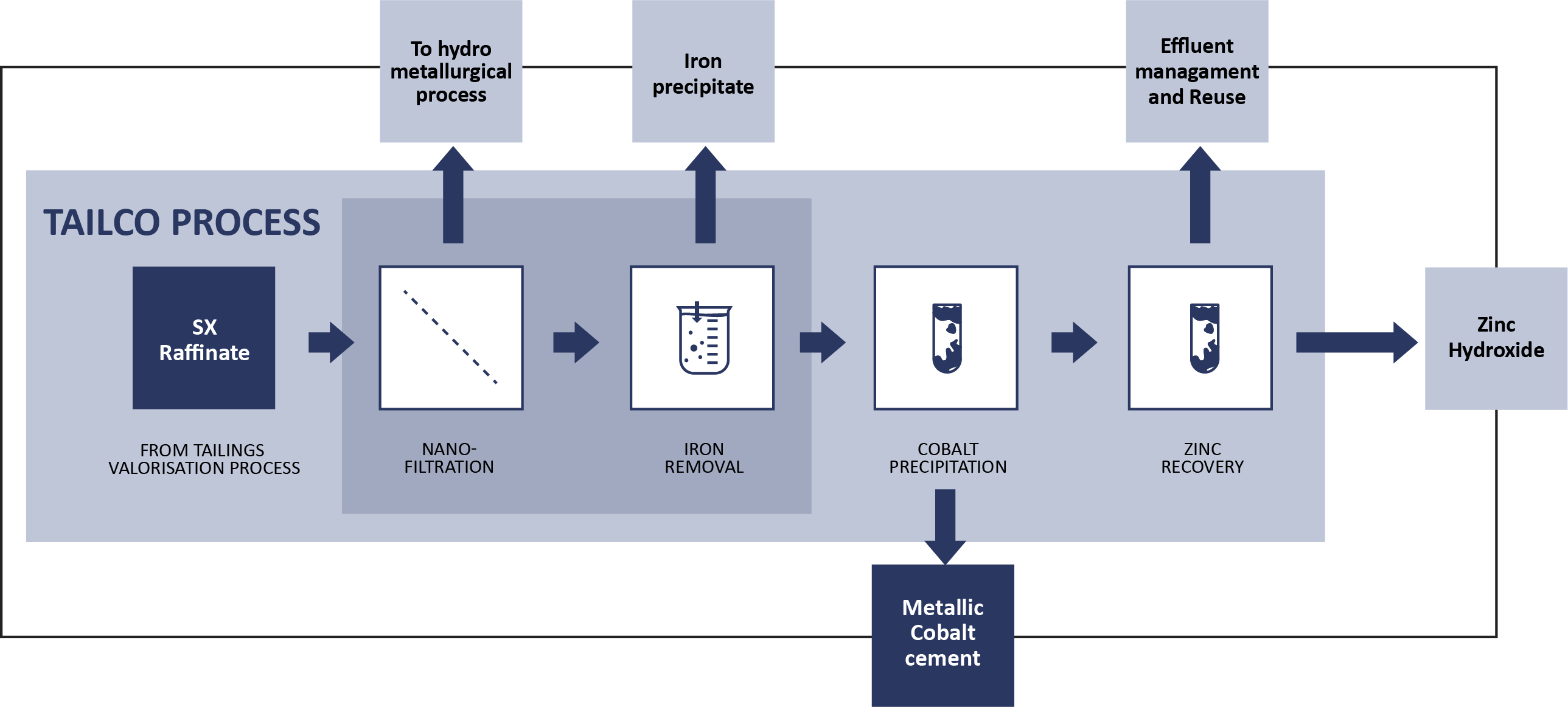
Figure 1: The TAILCO Process.
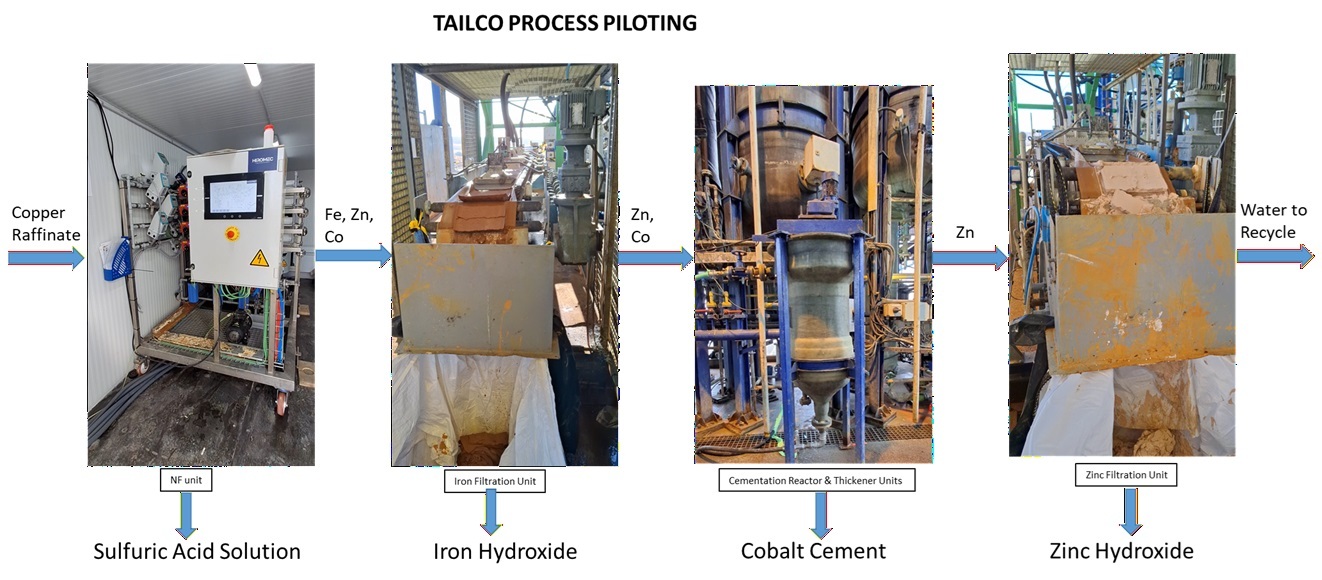
TAILCO Piloting Images Diagram.
Subsequently, the operational campaigns carried out in the pilot plant were conducted using the processing parameters defined during the laboratory-scale tests, with the aim of validating them. Figure 2 visually shows the main process equipment, as well as the process flow and the generation of products and by-products.
As of today, the calculations and mass balances required to determine the final pilot results are still being completed. Nevertheless, the values obtained so far are confirming the initial expectations. It can be stated that the results are very promising and support the suitability of the proposed processing approach.
Image source: CLC