
METALLICO Young Researchers: Damir Zuljevic
Recovering valuable raw materials, demonstrating sustainable production or developing innovative technologies: Many young researchers are doing their part to achieve the goals of the METALLICO project. They are highly motivated and passionate about their work. One of our "METALLICO Young Researchers" is Damir Zuljevic. He is a Scientific Associate at TU Bergakademie Freiberg at the Institute for Technical Chemistry. Currently, he is working on the development and optimization of the COOL+ Process. Read more about Damir and his motivation.
What is your motivation, and what excites you the most about your work?
Lithium is a vital element in the context of contemporary global energy transition. Securing a sustainable lithium supply is among Europe’s foremost strategic priorities, given the EU's significant dependency on imported critical raw materials and its commitment to decarbonization and clean energy initiatives. My motivation is rooted in the opportunity to develop advanced methods for producing lithium products (for example, Li2CO3), such as the COOL+ Process, which presents an environmentally responsible approach to extraction. By integrating chemistry, chemical engineering, and materials science, I aim to address key technical challenges while pursuing continuous development and learning. Contributing to solutions for the continent's resource challenges is both professionally rewarding and essential to advancing innovation in this field.
Which impact do you think your research will have on the future? What do you hope to achieve with your research?
I believe my research can help shape the future of sustainable lithium production. Current processes are often energy-intensive and environmentally burdensome (especially given the amount of solid residue waste produced), while demand in Europe and globally is rapidly growing. With the COOL+ Process, I aim to demonstrate a lower-temperature, selective, and scalable route for extracting lithium from minerals (such as spodumene and petalite), and aligning with zero-waste principles. The impact I foresee is twofold: reducing the environmental footprint of lithium production and strengthening Europe’s independence from imported raw materials. Even though everything takes time, my objective is to advance scientific understanding while establishing a practical approach that encourages industrial implementation and supports the development of a more resilient and sustainable battery value chain.
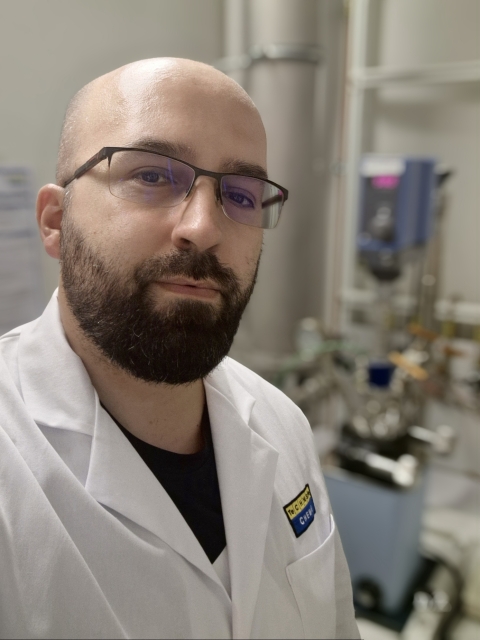
Damir Zuljevic, Scientific Associate at TU Bergakademie Freiberg at the Institute for Technical Chemistry. @Damir Zuljevic
What opportunities does the research project METALLICO offer you as a young researcher in your early career?
With a background in industrial innovation and R&D, I recognise the METALLICO project as an outstanding platform for advancing my development as a researcher. Scientifically, it enables engagement across key disciplines such as chemistry, mineral processing, hydrometallurgy, and materials science, and facilitates direct contributions to Europe’s raw materials strategy. The project also offers access to an extensive international network of universities, research institutions, and industry partners, providing valuable opportunities for collaboration. Furthermore, METALLICO enhances my expertise by bridging experience gained in industry and research, deepening my understanding of how scientific advancements are implemented within industrial settings. Participation in this significant European initiative not only allows me to contribute toward collective objectives but also supports the growth of my skills, visibility, collaboration, and professional perspective.
What is the best thing about your job as a scientist in the METALLICO project?
Working as a researcher at METALLICO offers considerable variety. Each week presents new experiments, data, and insights. The role involves connecting fundamental chemistry with applied challenges relevant to the project’s goals. Progress frequently results from unanticipated observations. For example, after extended calcination, instead of the expected powder, a glassy structure formed that could not be broken. On another occasion, a leaching solution was left to stand for a week after initial processing. The solution has changed, and some precipitate was at the bottom of the flask. Both instances provided significant findings following analysis. These occurrences illustrate that scientific research is seldom routine; discoveries often arise from unexpected results, and the process involves continual exploration rather than a straightforward path.
Find Damir on LinkedIn!