
Building the METALLICO Battery Metals Inventory
Mapping resources to support future battery metals recovery.
One of the key results of METALLICO is the Battery Metals Inventory, a tool designed to gather important information about resources that may contain valuable metals for batteries. In simple terms, it is a structured database that helps identify where these resources are located and what they contain.
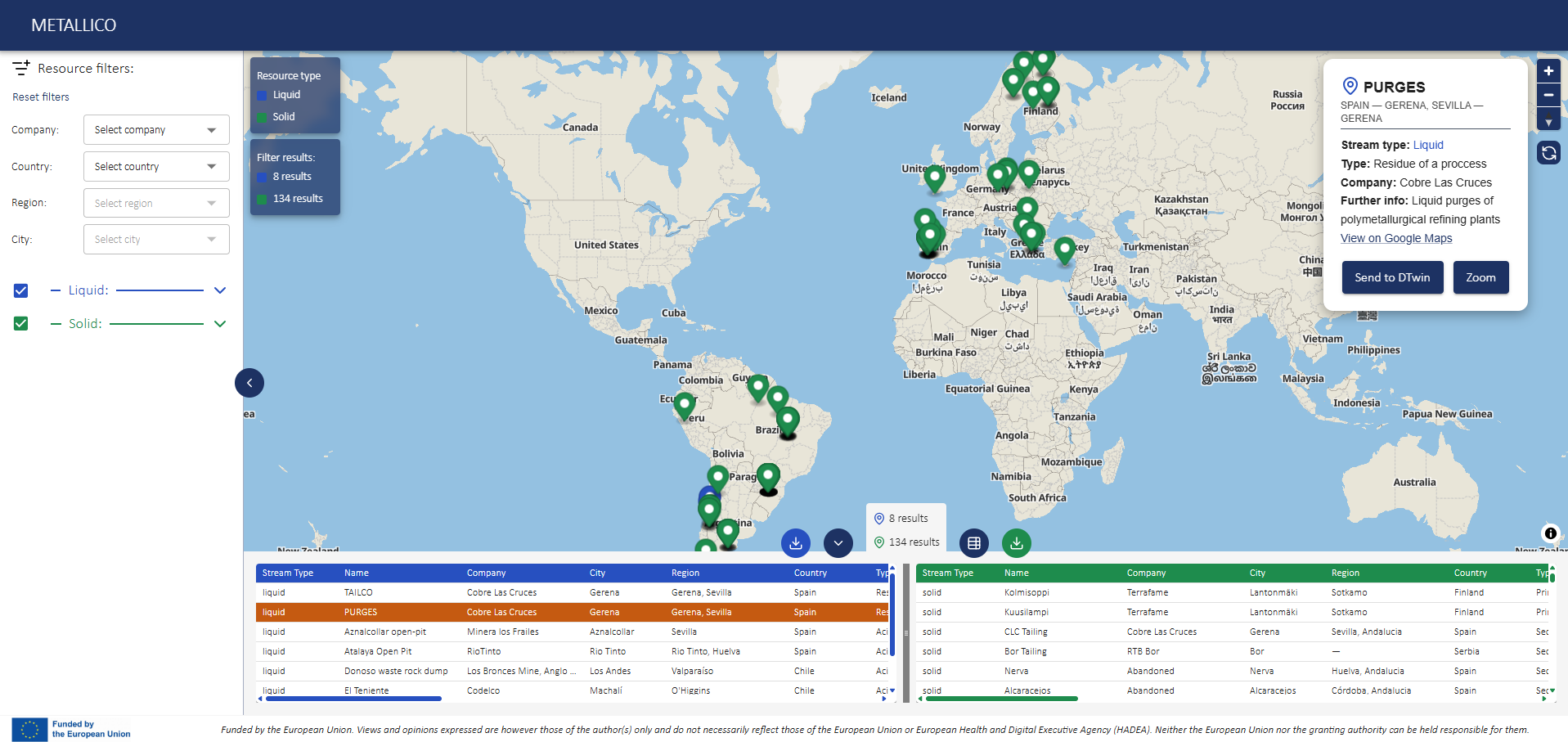
Metallico Digital Platform interface, developed by Cetaqua.
One of the key results of METALLICO is the Battery Metals Inventory, a tool designed to gather important information about resources that may contain valuable metals for batteries. In simple terms, it is a structured database that helps identify where these resources are located and what they contain.
The inventory includes both primary and secondary resources. Primary resources come directly from nature, such as mineral deposits. Secondary resources come from industrial activity, such as waste, tailings, slags or other leftover materials that may still contain useful metals. By bringing this information together in one place, the inventory helps create a clearer picture of the opportunities that already exist in Europe and in the CELAC region.
This work is important because battery metals such as lithium, cobalt, nickel, copper and manganese are essential for the energy transition. At the same time, Europe still depends strongly on imports for many of these materials. The METALLICO Battery Metals Inventory helps address this challenge by showing where promising resources can be found and by improving knowledge about their composition.
The work carried out so far has already gone well beyond the original target. Cetaqua-Water Technology Centre and UPC have worked together to identify, locate and characterise resources in the CELAC and European regions. As a result, 137 streams from primary and secondary sources have already been characterised across 28 sites in countries including Chile, Argentina, Brazil, Peru, Spain, Serbia, Cyprus, Greece, Poland, and Finland. The inventory also includes information related to the materials studied within the METALLICO project itself.
Moreover, the inventory goes beyond being a simple map of resources. It is being integrated into the wider METALLICO Digital Platform, where it is combined with the Digital Twins Tool developed by IDENER. This means that the information stored in the inventory can be used directly as input for simulations, helping users assess whether METALLICO recovery processes could be applied to other materials or in other locations. In this way, the inventory becomes part of a practical decision-support tool that connects resource mapping with process evaluation.
Cetaqua is leading the development of the inventory and its implementation within the wider METALLICO digital environment and contributing to the identification and characterisation of resources in the CELAC region, while UPC is doing the same for Europe. The final aim is to provide a useful and accessible tool for different audiences, from researchers and companies to public authorities and citizens interested in the future of battery metals recovery.
Image source: CETAQUA